The national flag
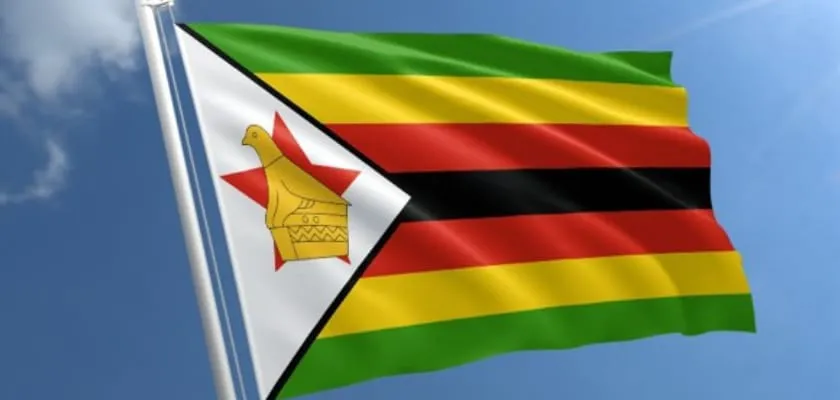
The flag of Zimbabwe was first raised at midnight on 17–18 April 1980, the moment of independence. It has seven equal horizontal stripes, green, gold, red, black, red, gold and green, and a white triangle at the hoist edged in black. On the triangle is a red five-pointed star bearing the gold Zimbabwe Bird.
- Green: vegetation and agriculture
- Gold: the country’s mineral wealth
- Red: the blood shed in the liberation war
- Black: the black majority
- White triangle: peace
- Red star: the nation’s hopes and aspirations
- Zimbabwe Bird: the national emblem
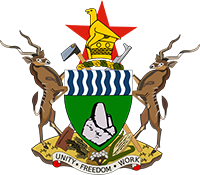
The coat of arms
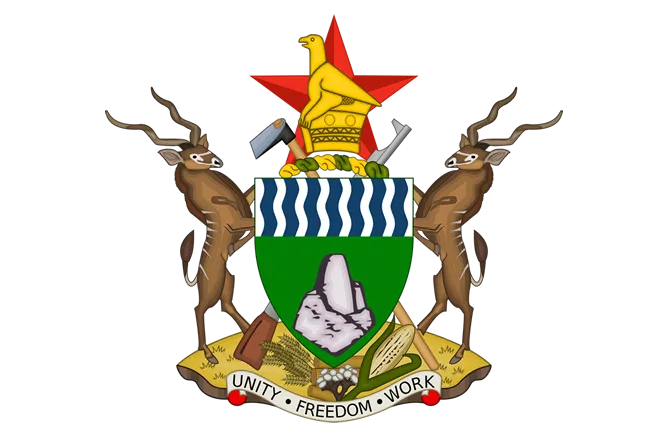
The coat of arms was adopted in September 1981.
- The two kudu blend black, white and brown, for the unity of the country’s peoples.
- The green shield stands for the fertility of the soil, and its blue and white wavy lines for the water that brings prosperity.
- Great Zimbabwe on the shield stands for the nation’s historical heritage.
- The rifle and hoe mark the move from war to peace.
- The earth mound bears the crops that feed and clothe the people.
- The gold and green wreath stands for the mining and farming that support the economy.
- The red star is a symbol of hope for the future, red for the suffering of the people and the need that it never happen again. It bears the Zimbabwe Bird.
- The motto, “Unity, Freedom, Work”, recalls the need for national unity and the will to work to preserve freedom.
The Zimbabwe Bird
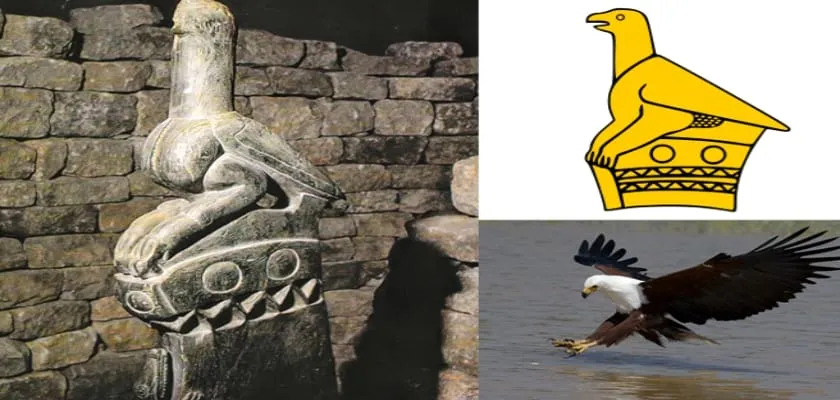
The stone-carved Zimbabwe Bird is the national emblem. It appears on the flag and the coat of arms, and on the country’s banknotes and coins. The original birds, carved in soapstone, were found at Great Zimbabwe. They are thought to represent the bateleur eagle (chapungu), held to be a messenger of God (Mwari) and the ancestors, or the fish eagle (hungwe).
The national anthem

“Proudly Lift High the Flag of Zimbabwe”, Simudzai Mureza wedu WeZimbabwe in Shona and Kalibusiswe Ilizwe leZimbabwe in Ndebele, became the national anthem in March 1994. It was chosen in a national competition. The words are by Professor Solomon Mutswairo and the music by Fred Changundega. It replaced Ishe Komborera Africa, and it is sung in English, Shona and Ndebele.